Not every artificial grass project requires a professional crew, and we'll be the first to say so. DIY works well - genuinely well - in the following scenarios:
Hard surfaces: balconies, patios, and decking - If your surface is already level and stable, the hardest part of the job is already done. You're essentially laying a high-quality outdoor carpet. These are the ideal DIY projects.
Small, simple areas - A compact urban yard with no complex curves, no drainage challenges, and a clean existing surface is well within reach for a capable homeowner with a free weekend.
Budget-conscious projects - Professional labour in Ireland typically costs between €10 and €40 per m², depending on complexity. On a 30m² garden, that's a potential saving of €300–€1,200 - meaningful money. If you have more time than spare cash and a suitable surface, DIY is a legitimate option.
For these projects, Sanctuary supplies everything you need: EU-manufactured grass, professional-grade adhesive, seaming tape, and full technical guidance to ensure your joins are clean and your finish is sharp.
Before committing to the DIY route, it's worth knowing what you're signing up for. Beyond the grass itself, a proper installation requires:
A full garden transformation isn't a surface job - it's an excavation project. The grass you see accounts for roughly 10% of the work. The remaining 90% is the invisible infrastructure built to handle Irish weather conditions year after year.
1. Excavation and the "Irish Bog" Problem
Irish soil has a memory. If you strip the top layer of sod and lay directly onto sand, the organic matter left behind will rot and cause the ground to dip. Old roots and seeds will fight their way through your new lawn within a season or two.
A professional team excavates to a minimum depth of 100mm, removing soil entirely to create a clean, stable base with no organic material remaining.
2. The Sub-Base "Cake"
This is where most DIY installs eventually fail. The Sanctuary method uses a structured, layered approach:
Builder's sand, the common DIY shortcut, shifts. Two or three Irish winters later, you'll have hollows where water collects and humps where it doesn't drain. We see it regularly.
3. Stretching and Seaming
Professional fitters use a knee kicker - a stretching tool that pulls the grass drum-tight before fixing. Without it, grass laid under tension will relax over time, developing ripples and raised seams that become trip hazards. Adhesive application temperature matters too - below 5°C, most artificial grass adhesives won't cure correctly, a detail that catches out many autumn DIY projects.


We regularly receive calls from homeowners who went the DIY route - or hired a "man with a van" at a suspiciously low price. The story follows a familiar pattern.
The garden looked great for the first six months. Then came a typical Irish winter. Without a compacted 804 base, the heavy rainfall caused the sub-soil to shift. A large puddle formed in the centre that wouldn't drain. The seams - once invisible - began to pull apart. The grass developed ripples that weren't there in September.
The problem with fixing these issues is that you can't patch them. You have to skip the old materials, excavate the failed base, and start from scratch. In effect, the homeowner pays for two installations to get one that works.
This is the question most homeowners don't think to ask until it's too late.
Sanctuary's 10-year product warranty covers manufacturing defects regardless of who installs the grass. However, our workmanship guarantee - which covers drainage performance, seam integrity, and surface levelness - applies exclusively to installs completed by Sanctuary's own crews.
If a DIY install develops drainage or seam issues, the product itself may be fine, but the installation outcome isn't covered. For a balcony or patio project, this is a reasonable trade-off. For a full garden install representing €1,500+ in materials, it's worth factoring in.
Timber decking - Yes
Notes: Can be fixed directly using screws or adhesive.
Concrete / tarmac - Yes
Notes: Ensure proper drainage falls are in place before installation.
Old paving slabs - Maybe
Notes: Only suitable if the slabs are level, stable, and in good condition.
Existing soil / lawn - No
Notes: Requires full excavation and installation of a proper sub-base.
Flat roof / balcony - Yes
Notes: One of the most straightforward and suitable DIY applications.


A common concern is that professional artificial grass means a sterile, all-green space. In practice, the opposite is true. Our fitters are experienced at scribing grass precisely around mature trees, raised beds, and hedging - installing the 804 base right up to the root flare of established trees without causing damage. The approach gaining the most traction in Irish garden design right now is a hybrid layout: artificial lawn as the central, low-maintenance surface, with natural pollinator-friendly borders and planted beds framing it. It's practical, sustainable, and visually far more interesting than wall-to-wall green.
Choose DIY if: You have a hard, stable existing surface, a simple layout, and you're willing to hire the right equipment including a plate compactor.
Choose professional installation if: You're working with soil, your garden has any complexity, you want a workmanship guarantee, or you simply want it done once and done right.
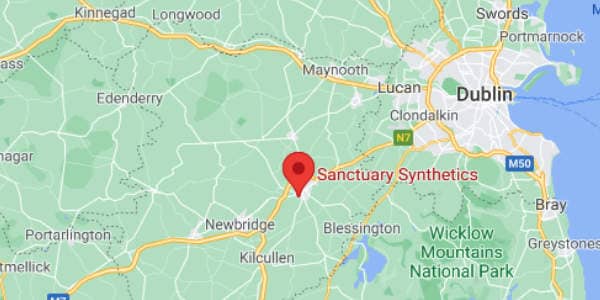
At Sanctuary Synthetics, we're happy to support either path. If you're going DIY, we'll supply the right materials and the technical guidance to give your project the best possible chance. If you'd prefer to hand it over, our installation teams cover Dublin, Kildare, Wicklow, and beyond.
Get a free quote or a DIY materials pack - call us in Naas on (045) 901 970 or email info@sanctuarysynthetics.ie